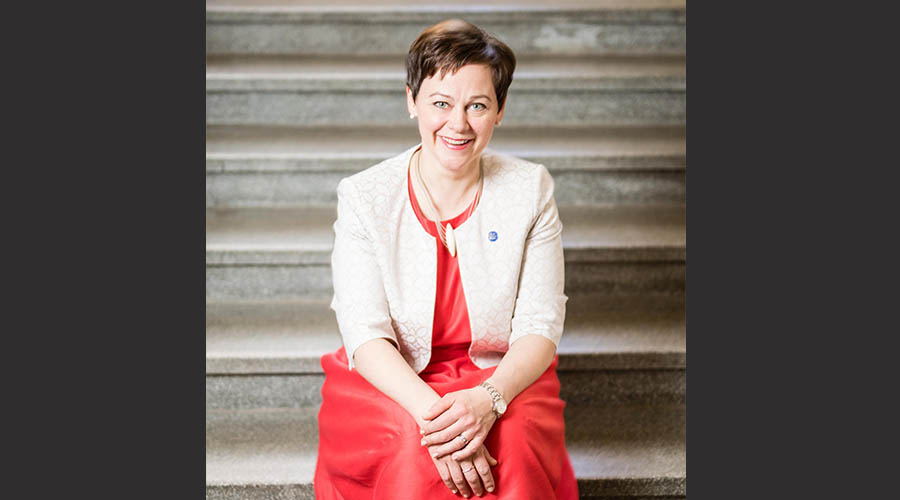
07 Oct Interview with Paula Lehtomäki, Secretary General, Nordic Council of Ministers
Paula Lehtomäki, Secretary General, Nordic Council of Ministers, outlines the region’s key strengths and steps the Nordic Council is taking to see its Vision 2030 initiative come to light.
What is the Nordic Council’s role in the region?
We exist to support governments in their cooperative endeavors and policies. We do not have the same legislative power as the European Union; it is a completely different kind of cooperation. However, we are very focused on identifying concrete issues and solutions to add value to the region. We have very tight cooperation between our individual countries, in particular the country that holds the chairmanship, which rotates on a yearly basis. This year it is Finland, and we are in close collaboration with the chairman to drive the common agenda forward. Cooperation is a tool to help national governments solve complicated issues. Although we have differences, Nordic countries are also very similar. We share many similar social issues, whether it be the green transition or lifelong learning. It is important we offer a platform where countries can share experiences and generate and accumulate better knowledge on what solutions work and what solutions do not.
It is important to remember that Nordic cooperation is very much value based. The similarities we see between countries are based on the following common values: transparency, equality, inclusiveness, openness and rule of law. We are constantly discussing on a political level which way we should operate in the international arena. We have a very stable framework of different global agreements in biodiversity and environment, such as the Paris Agreement. Nordic countries have political discussions and take concrete actions in UN Climate Change Conference meetings and other international summits. Another important area of cooperation is the UN Commission on the Status of Women, the Beijing process and everything the United Nations is doing for women’s rights, including the Beijing Declaration and the Platform for Action.
A specific challenge for Nordic countries is that some countries are part of the European Union, and some are not. It is reflected in our discussions and is an important area of our cooperation. We launched a survey in the spring where we asked more than 3,000 people in the Nordic countries what they think about our cooperation. The strongest common voice was in support of Nordic cooperation. While traditional foreign policy is not within our mandate or work as the Nordic Council of Ministers, it is natural that international issues are discussed.
What are the key goals of the Nordic Council’s Vision 2030?
The Nordic prime ministers decided in August 2019 that the Nordic region should become the world’s most integrated and sustainable region by the year 2030. This vision consists of the three following key elements: green transition, making the region competitive and becoming socially sustainable. To put our vision into action, we have prepared and adopted an action plan that consists of twelve goals based on these three strategic areas that take the initiative in a more concrete direction. These relate to decreasing carbon dioxide emissions, making transportation free of fossil fuels, creating a circular and bio-based economy and making it easier for Nordic consumers to make sustainable choices. Nordic countries and the region are strongly committed to a green transition. However, we want to do it together with the rest of the world; these challenges must be solved among all of us together. Our vision ranges from grassroots work with Nordic consumers all the way to political-level discussions and operations.
What elements does the region have that have kept its economies so robust?
One of the region’s key strengths is trust, not only at a country level, but also on an individual level regarding public organizations and public power. This has been clearly seen in different practical issues connected to the pandemic. Our trust is based on a long tradition of openness, transparency and inclusiveness. In terms of the green transition, for example, it is extremely important everyone is kept on board and that no one is left behind. Another issue in Nordic economies and in the working life here is the tripartite method. There are well-advanced mechanisms for the discussions between employees, employers and authorities. Nordic economies are also looking towards a partial-work method. However, challenges always exist. Digitalization and all that it brings is another challenge. We strongly believe our investments in innovation and the core idea of utilizing all our human power will carry us past these challenging circumstances.
What major issues did the COVID-19 pandemic raise in the Nordic region?
The development of the labor market within Nordic countries is evolving well. However, if we look at the Nordic region as one market, we have taken a strong hit due to borders being closed. It is much better now that they have opened. The pandemic hit the Nordic region as it has the whole world. However, after facing the worst, recovery seems to be quite strong. Employment rates are now improving in Nordic countries and recovery in many areas is ongoing.
We identified and solved some concrete issues during the pandemic. We were able to work on tax rates, legislation and social security issues for workers who live in one country and go to work in another or do so through mandatory remote work. We have never had this situation before. Some issues remain to be solved and we are continuing to work on them. What we do see as a challenge is how to boost integration in the labor market so people can move around and travel to other Nordic countries with ease. We have issues with mutual recognition of different levels of diplomas and certifications in working places. Hiring a professional varies from country to country. We are actively collaborating to solve these issues. One of our main purposes is to make it as easy as possible for individuals and companies to move to another country and operate. We have not reached where we want to be, but we are working intensely to make it happen.
What are your personal goals as secretariat general for the Nordic Council of Ministers?
My mission is particularly focused on the secretariat. The substance of our cooperation is clear now that the prime ministers have adopted a vision. My goals are to develop our work in such a way that we can better map out the political landscape. We must find the best areas for cooperation. We tend to be very structure oriented, but it would be good to become more phenomenon or topic oriented in such a way that this kind of cross-sectoral cooperation becomes more fluent and effective. It is not only important what we do, but what we achieve by our actions. We have room for improvement in evaluating the effects of our work in real life.
Sorry, the comment form is closed at this time.