
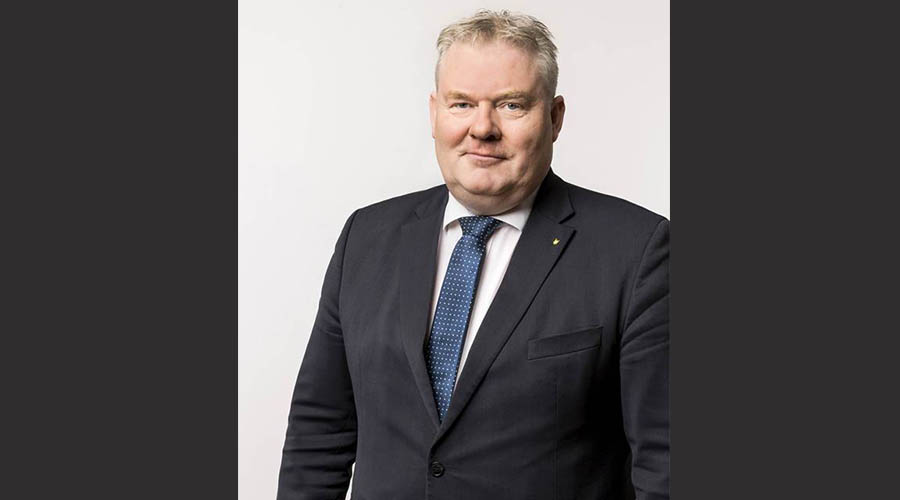
07 Oct Interview with Sigurður Ingi Jóhannsson, Minister of Transport and Local Government, Iceland
Sigurður Ingi Jóhannsson, Minister of Transport and Local Government, Iceland, details the country’s successful fight against challenges caused by the COVID-19 pandemic and recent initiatives the government has put in place to drive sustainability and economic growth.
How is Iceland rising to meet the challenges that the COVID-19 crisis caused?
The pandemic is rising everywhere. In Iceland, our government aims to safeguard the general health of residents and economic livelihoods of businesses while protecting the welfare system and creating strong demands in the economy. Our goal is to secure stability and keep society going given the circumstances of the pandemic, which is continuously changing. Our strategy is to meet the current crisis on the offensive by not raising taxes or making heavy cuts to the budget, but rather investing more in all areas where it is both feasible and economically favorable. By doing so we will safeguard jobs and the welfare system. Our strategy is to make the best out of this unprecedented situation and invest wisely in the construction of roads and public transportation for the creation of jobs to stimulate the economy and foster innovation and infrastructure for our tourism sector. We are using this time to build up our infrastructure for the future. We know that when demand for travel rises again, we will be a preferred destination, perhaps more now because of how we have dealt with the pandemic in Iceland.
Iceland was one of the first countries in Europe to create a policy for quarantining, isolating and performing high-volume testing and contact tracing. All our measures were made to protect public health and our healthcare system, which remains our main aim. We rely on the active cooperation and responsible behavior of the general population, which extends to everyone who visits Iceland. The government began easing restrictions on international arrivals in June 2021 and we experienced an increase in tourism. The government had to impose more comprehensive measures in August given the increase in infections worldwide and the widespread effect that a small outbreak could have on the functioning of our society.
There is a consensus to use science to tackle the pandemic. The government has cooperated closely with scientists and experts in every field. I am incredibly proud to witness the unity of the nation and the solidarity of our people. Iceland has fought the virus together and adopted individual responsibility following strict measures when needed. This nation has faced natural disasters before; it is in our blood to stick together at times like this. We are optimistic that we will bring the current situation back to normal soon. We have learnt a valuable lesson and hopefully we will grow as a society.
What infrastructure projects is Iceland undergoing to support its growing tourism sector and economy?
Tourism and aviation are major economic forces in Iceland. The aviation sector has become increasingly important in recent years and is now a major contributor to our gross domestic product (GDP). Oxford estimated that aviation and related activities took up about 6.6% of our GDP in 2010. Since then — and before the COVID-19 pandemic — the number of passengers passing through Keflavík International Airport rose from 2 million to about 10 million at its peak in 2018. The estimate for air transport and tourism rose to 38.3% of our GDP and supported 72,000 jobs in 2017. We have witnessed phenomenal growth in this sector in the last ten years.
The objective of our aviation policy is to support economic growth and create jobs. The government is looking to open more international gateways into the country, not only in the southwest area of Iceland where the Keflavík International Airport is located but the whole country. We are currently renovating and expanding the terminal in Akureyri, the largest town in the northern part of Iceland. We are also making improvements to the airport in Egilsstaðir, which houses the main airport in the eastern part of Iceland. The main function of this asset is to serve as a reserve airport for Keflavík International Airport. We are also looking at our harbors as they are important for the fishing industry and transportation of goods. While most are operated by municipalities, our overarching goal is to improve the capacity of harbors for the transport of goods. Iceland relies on shipping for almost 99% of its goods, despite our solid aviation infrastructure. A new transport link is under development and growing fast in the south of Iceland.
How is the government supporting these new infrastructure projects?
The government introduced an important investment initiative in the spring of 2020 to cope with the foreseeable economic effects of the pandemic. It was a diverse investment plan of USD 154 million, with a heavy focus on transport. The criteria for the selection of transport projects that are to receive funding is safety, economic viability and job creation. These investments were added to our existing 15-year national transport plan. The economic crisis in 2008 and the surge in tourism after 2012 paralyzed this plan; there is a lot of infrastructure that needs to be built. We will discuss a further stimulus plan for the next few years to protect the economy, preserve jobs and increase the effectiveness and the value of our transport system. We will require similar investments of USD 154 million three or four times in the next three or four years.
The investment initiative has allowed us to speed up the construction of large economically feasible expansion projects in all modes of transport. We are now planning to speed up construction of our highway system to increase safety and capacity in main cities and to and from the capital area. Regarding our harbors, we are studying opportunities in several places that will greatly boost economic activity through investments in buildings and logistics. In aviation, we continue to invest in our main international airport. The latest investment initiative has put the long overdue focus on all of Iceland’s international airports. We hope this will allow them to develop and create more international links, thereby supporting local tourism and related industries in the years to come.
What is Iceland doing to decrease its carbon dioxide emissions and combat climate change?
Despite the COVID-19 pandemic, it is important that other topics continue to be priority items on the global stage. We have been talking about climate change and what measures our government has initiated in recent months. Iceland is expected to exceed a 35% reduction in greenhouse gas emissions from 2005 levels by 2030, and we are making a huge effort to reduce this target. The Paris Agreement requires a 29% reduction, which we have surpassed. According to rough estimates, additional measures currently under development could result in a further decrease of up to 11%, bringing the total reduction in emissions to 46%. The government’s Climate Action Plan marks a turning point in climate issues in Iceland. We need to ensure that the public take part in changes that need to take place. Every person’s contribution matters. The energy transition in transport plays a major role in this area.
Iceland has economic interest in switching to green energy sources. Many billions currently flow out of the country to buy fossil fuels. The government has initiated a study on how we can increase the use of domestic green biofuels for the transportation industry in both vehicles and ships. The first electrically charged ferries started sailing between the western Islands and the mainland at the end of 2019. This ferry is the most important maritime passenger link in Iceland and transports more than 2,000 people every year. Our goal is that all ferries run on environmentally friendly fuel — most likely electricity — to minimize their carbon footprint. This will be implemented as ferries are renewed or replaced. Finally, the government is exploring ways to increase the chance for electric connection and charging in Icelandic harbors. This effort will require the cooperation of different stakeholders, ministers and municipalities. We will use our own energy, which we are producing through hydropower and geothermal sources, to avoid paying for expensive fossil fuels. The transition is both economically viable and climate friendly.
How significant is Iceland’s relationship with the U.S.?
The U.S.-Iceland partnership has always been an important factor in our foreign policy, and we have maintained good relations. There are many opportunities to make our relationship stronger. We see foreign investment as very positive. There are opportunities regarding our expertise in fisheries, energy and different innovative industries. We are looking into supporting new economic sectors driven by innovation to create jobs based on the human mind.
Sorry, the comment form is closed at this time.