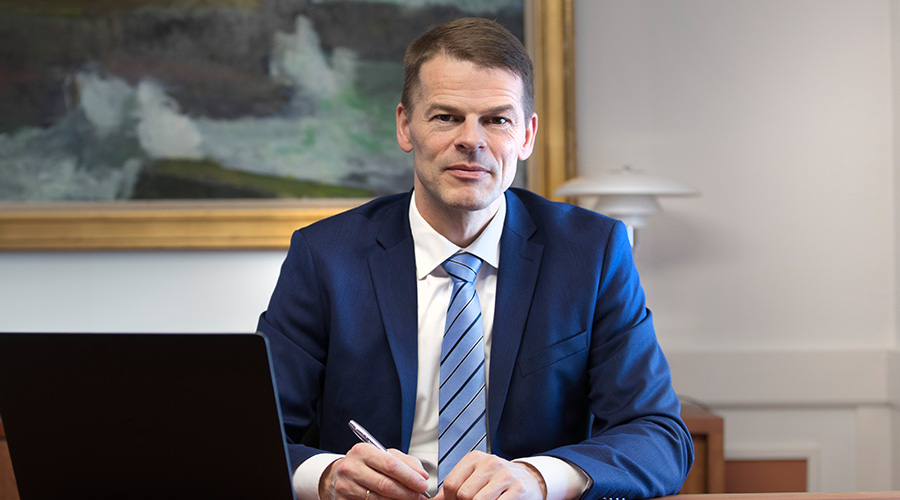
07 Oct Interview with Bárður á Steig Nielsen, Prime Minister, Faroe Islands
Bárður á Steig Nielsen, Prime Minister, Faroe Islands, discusses the nation’s key strengths and recent economic rise as well as its unique and successful COVID-19 strategy.
What specific challenges does the Faroe Islands face and how is it looking to grow its economy?
We are facing similar challenges that other political leaders face. We have a modern society and are looking to provide jobs, homes and security for our population. We are careful in how we create sustainable growth to increase our welfare standards for generations to come. We are working to promote our natural resources in multilateral negotiations. In our case, it is the promotion of migrating fish species, such as mackerel, herring and the blue whiting. Our salmon sector is strong. We live quite close to nature; almost 95% or more of our exports come from the sea.
One of our main goals is to have good relationships with countries all over the world. We sell our products to China, the U.S., Europe, Russia and all over. We try to have as good a trade agreement as possible with each of our partners. We are working on developing free trade with the EU and other countries with which we already have a good relationship. We have very good ties with all Nordic countries and neighbors. As the Faroe Islands is a small country, we prioritize representation in the seven following countries: Denmark, Iceland, the U.K., Russia, Belgium, China and now Israel. We think that we can benefit from these countries, and therefore have installed representative offices. We are represented almost all around the world. These offices also work as a platform to build new relationships for our fish products.
What effects did the COVID-19 pandemic have on the population?
The pandemic had some impact on the Faroe Islands, although we have been living almost normally for one and a half years. In the beginning we had some shutdowns, but after we were back to school and doing sports. However, we have had to keep to the new norms of social distancing, washing hands and so on. Tourism was open last summer and saw some good months. Essentially, we have not been hit as hard as our neighboring countries. We managed everything without making laws and using only recommendations to keep distances, be careful of others, go to testing, quarantine and not have large parties with many people.
Trust in the people has been central to the state’s pandemic strategy from the beginning. When a government feels that it can trust its citizens to do the right thing, it can avoid implementing bans. It also meant businesses had more responsibility in their own behavior and were more interested in following recommendations. When cases rose, businesses shut down. Most of our people have taken the pandemic very seriously. If there is anything we have learnt here in the Faroe Islands during the past year and a half, is that trust is an extremely valuable asset in society. When people trust the government, public services, private businesses and each other, everything works for the better — not only in the management of the pandemic but in all areas of society. The Faroe Islands have been a kind of testing ground for recommendation-based management of the pandemic. It has worked quite well. However, all societies are different. I remain convinced that a high level of trust is beneficial and conductive to constructive dialogue and sensible solutions for a society and a country.
We were also able to have high testing numbers since the beginning of the pandemic. In around 2001 we had an outbreak of a salmon virus that ravaged the species. We built up a system to test and track the virus. We adapted this system into testing people for the COVID-19 virus. From the beginning we were able to test, trace and track individuals. We had a lot of people in the tracking system and when somebody was tracked as being too close to somebody who had COVID-19, this person went into quarantine in a hotel for 14 days. It has been humbling to be at the head of all these fantastic citizens during the last 18 months.
What major pillars does the Faroe Islands’ economy rest on?
We have a gross domestic product per capita that is amongst the highest in the world, especially in the last ten years due to growth in our salmon industry. We have grown our year-on-year gross domestic product for many years. Our growth rate is about 5%, with a small drop in 2020 due to the pandemic. We are already at the same growth level or higher in 2021.
We are historically a maritime nation, with many of our people working around the world. We are flexible workers. Fisheries, shipping and maritime services are a natural part of our business, and we have many successful companies in these areas. Salmon farming in the Faroe Islands is one of our most successful stories in the last ten to 15 years. After the previously mentioned salmon disease, we went down having almost no production or farming. We made changes to legislation and now half our exports come from the salmon industry. We currently have the best salmon in the world and are getting extra premiums for its high quality. It is in high demand around the globe. Our competitive advantage is our clean ocean and healthy environment. The Faroe Islands also has many innovative companies and entrepreneurs that are attractive to international investment.
What kind of sustainable initiatives is the government introducing?
We initiated a forum for sustainable growth. We are concerned about maintaining and improving the current level of welfare because people are getting older. It is the heavier part of our budget. The way forward is through concentrating on long-term, sustainable growth. One of our goals is to be 100% green from our land operations by 2030. Many investments are required, but we believe we will benefit from it in the long run. We have the possibility for renewable energy production in the form of hydro, wind and tides. We are looking to implement these strategies to reach our target. We are 100% dependent on the environment and are always thinking about ways to combat climate change.
Can you describe the Faroe Islands to potential visitors?
If you come to the Faroe Islands, it will be for our nature and fresh air. Even though we are located remotely in the middle of the northern Atlantic Ocean, visitors will find a modern society; we have almost everything. Gastronomy in the Faroe Islands is at a high level. For example, we have a two-star Michelin restaurant in — you could say — the middle of nowhere surrounded by beautiful nature. We mostly attract high-end tourists because it is not a cheap country. It is also expensive to travel here. We have modern hotels such as the Hilton Garden Inn Faroe Islands and other high-level hotels in Tulsa. Visitors can enjoy nature, fresh air, gastronomy, arts and music. Additionally, our football team is quite popular around the world.
Sorry, the comment form is closed at this time.